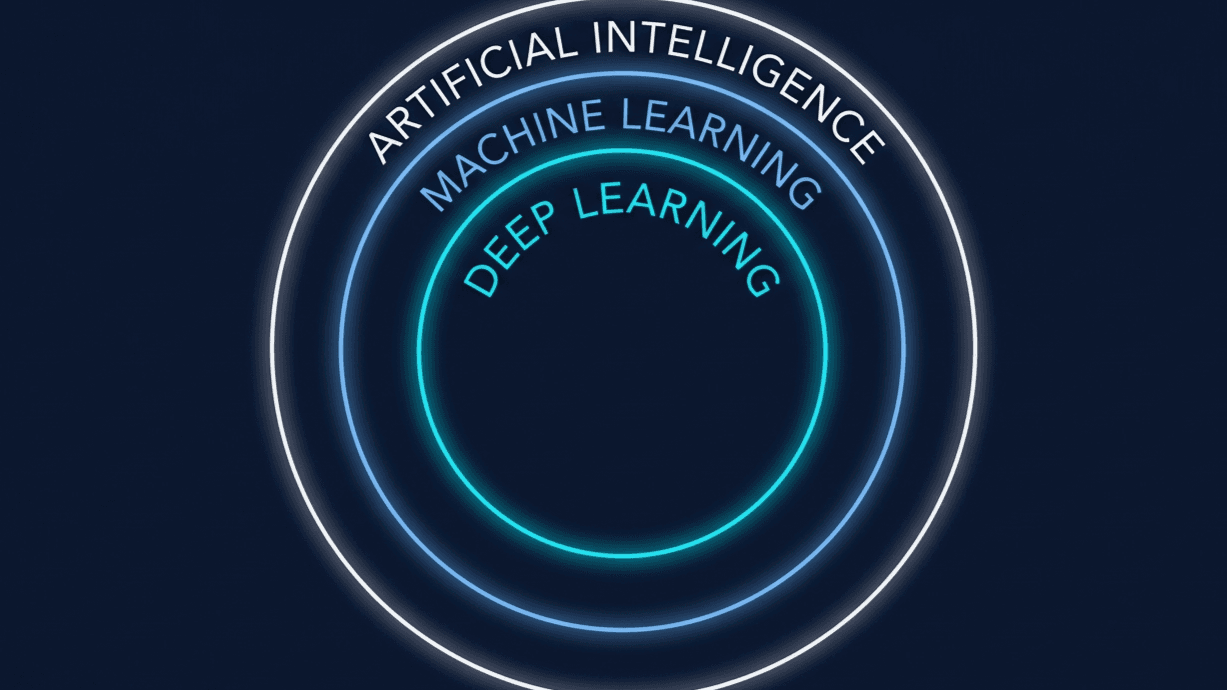
The short answer: AI is the big idea, machine learning is one way to achieve it, and deep learning is a powerful technique within machine learning. They are nested inside each other — not three separate things competing for the same title.
If you have spent any time reading about technology in the last few years, you have almost certainly seen these three terms used as if they mean the same thing. A product launch claims to use "AI." A news article says the same thing is powered by "machine learning." A researcher calls the underlying technique "deep learning." No wonder people are confused.
This guide cuts through that confusion once and for all — no engineering background required.
Start With the Biggest Picture: What Is AI?
Artificial intelligence is the broad goal of making machines behave in ways that seem intelligent. That is it. The definition is intentionally wide because it covers an enormous range of approaches, from basic rule-based systems to the most sophisticated language models in the world.
The earliest AI systems in the 1950s and 60s were not learning anything. They were following instructions. A chess programme from 1960 was "intelligent" in the sense that it could beat most humans at chess — but only because every possible move and counter-move had been manually coded in by a programmer. The machine was not thinking. It was executing a very large decision tree.
This kind of AI — rules written by humans, followed rigidly by machines — worked well for narrow, well-defined problems. It fell apart the moment the problem became too complex, too varied, or too dependent on unstructured data like images, speech, or natural language.
That limitation is exactly what machine learning was designed to solve.
What Is Machine Learning — And How Is It Different?
Machine learning is a specific approach to building AI systems where the machine learns patterns from data rather than following rules written by a human.
Think about the difference between teaching a child what a dog looks like by writing down rules ("four legs, fur, barks, tail") versus showing them ten thousand pictures of dogs and letting them figure out the pattern themselves. The first approach is traditional AI. The second is machine learning.
The breakthrough insight behind machine learning is that for many real-world problems — recognising speech, recommending a film, detecting fraud — it is simply not possible for a human to write down all the rules. There are too many variables, too many edge cases, too much nuance. It is far more effective to give the machine a large dataset of examples and let it discover the patterns on its own.
This is why machine learning became dominant from the 1990s onwards. E-commerce recommendation engines, spam filters, credit scoring systems, voice assistants — all of these became dramatically more capable once engineers switched from writing rules by hand to training models on data.
The important thing to understand: machine learning is still artificial intelligence. Every machine learning system is an AI system. But not every AI system uses machine learning. The term "AI" is broader.
What Is Deep Learning — And Where Does It Fit?
Deep learning is a specific family of machine learning techniques that use structures called neural networks — loosely inspired by the way neurons connect in the human brain — to process data through many layers of computation.
The "deep" in deep learning refers to the depth of these layers, not to the sophistication of the thinking (despite how it sounds). A deep learning model might process an input — an image, a sentence, an audio clip — through dozens or even hundreds of sequential layers, each one extracting increasingly abstract features.
For an image of a cat, the first layer might detect edges. The next layer might detect shapes made of edges. The layer after that might detect features like ears or whiskers. By the final layer, the network has built up a rich representation that it can use to say, with high confidence, "this is a cat."
Deep learning is what powers the most impressive AI you interact with today:
- Large language models like GPT-4, Gemini, and Claude — the systems behind ChatGPT and similar tools — are all built on deep learning architectures
- Image recognition in your phone's camera, in medical diagnosis tools, and in self-driving vehicles
- Real-time translation between languages
- Voice assistants that understand natural speech
- Music and image generation tools
Before deep learning became practical — roughly from 2012 onwards, when computing power and dataset sizes became large enough — many of these applications were either impossible or far less accurate.
The Nested Relationship Explained Simply
The cleanest way to understand the relationship between these three terms is to think of them as nested circles:
AI is the outermost circle — the largest, most general concept. Any system designed to perform tasks that seem intelligent qualifies as AI.
Machine learning sits inside that circle. It is a specific method for building AI systems — one where the machine learns from data rather than following hand-coded rules. Most modern AI is built using machine learning.
Deep learning sits inside the machine learning circle. It is a powerful subset of machine learning techniques — particularly effective for unstructured data like images, audio, and text — that uses multi-layered neural networks.
Every deep learning system is a machine learning system. Every machine learning system is an AI system. But not every AI system uses machine learning, and not every machine learning system uses deep learning.
Why Does This Distinction Actually Matter?
For most people — including non-technical founders, business leaders, and curious readers — the practical reason to understand this distinction is that it helps you ask better questions when someone tells you a product "uses AI."
If a vendor tells you their software uses AI, the follow-up question is: what kind? Is it rules-based logic? A simple machine learning model trained on historical data? A large deep learning model? The answer changes what the system is actually capable of, how it can go wrong, how much data it needs, and how much it costs to run.
It also helps you evaluate claims sensibly. Saying a product "uses AI" in 2025 is like saying a car "uses technology." It is technically true but tells you almost nothing useful. The meaningful question is which specific technique is being used, trained on what data, for what purpose.
A Quick Reference to Remember
| Term | What It Means | Powered By | Real Example |
|---|---|---|---|
| Artificial Intelligence | Machines performing intelligent tasks | Rules, ML, or deep learning | Any smart software system |
| Machine Learning | Machines learning patterns from data | Statistical algorithms | Netflix recommendation engine |
| Deep Learning | ML using multi-layer neural networks | Neural networks + large datasets | ChatGPT, image recognition |
Key Takeaways
- AI is the broad goal. Machine learning and deep learning are specific ways of achieving it.
- Machine learning replaced hand-coded rules with data-driven pattern recognition — a fundamental shift that unlocked most modern AI capabilities.
- Deep learning is a subset of machine learning that powers today's most impressive AI systems, from language models to image recognition.
- When someone says a product "uses AI," the meaningful follow-up is which specific technique, trained on what data, and for what purpose.
- Understanding these distinctions does not require a technical background — it requires understanding the question each approach is trying to answer.
Frequently Asked Questions
Is ChatGPT an example of AI, machine learning, or deep learning? All three. ChatGPT is an AI product. It is built using machine learning. The specific technique it uses is deep learning — specifically a transformer-based neural network architecture. All three terms apply simultaneously.
Do I need to understand machine learning to use AI tools? No. Just as you do not need to understand how a combustion engine works to drive a car, you do not need to understand machine learning to use AI tools effectively. But understanding the basics — which this article covers — helps you use them more intelligently and evaluate their limitations honestly.
Is deep learning always better than regular machine learning? Not always. Deep learning is more powerful for complex, unstructured data like images and text, but it requires significantly more data and computing power to train. For many business problems involving structured tabular data, simpler machine learning models perform just as well and are far cheaper and faster to build.